If you’re looking for a new way to approach affiliate marketing, you’ve probably come across Commission Cycle.
The training focuses on a simple idea: generate affiliate commissions, then reinvest part of those commissions into the part of the business that can produce the biggest improvement at that moment.
Rather than teaching dozens of unrelated strategies, Commission Cycle is built around one central model and several practical strategies that support it.
In this review, we’ll look at what Commission Cycle teaches, how the method works, the traffic sources involved, the AI tools included with the training, and the niches it focuses on.
What Is Commission Cycle?
Commission Cycle is an affiliate marketing training built around what its creator describes as the Commission Cycle Method. If you’re new to the business model, understanding how affiliate marketing works is a useful starting point.
The basic concept is straightforward:
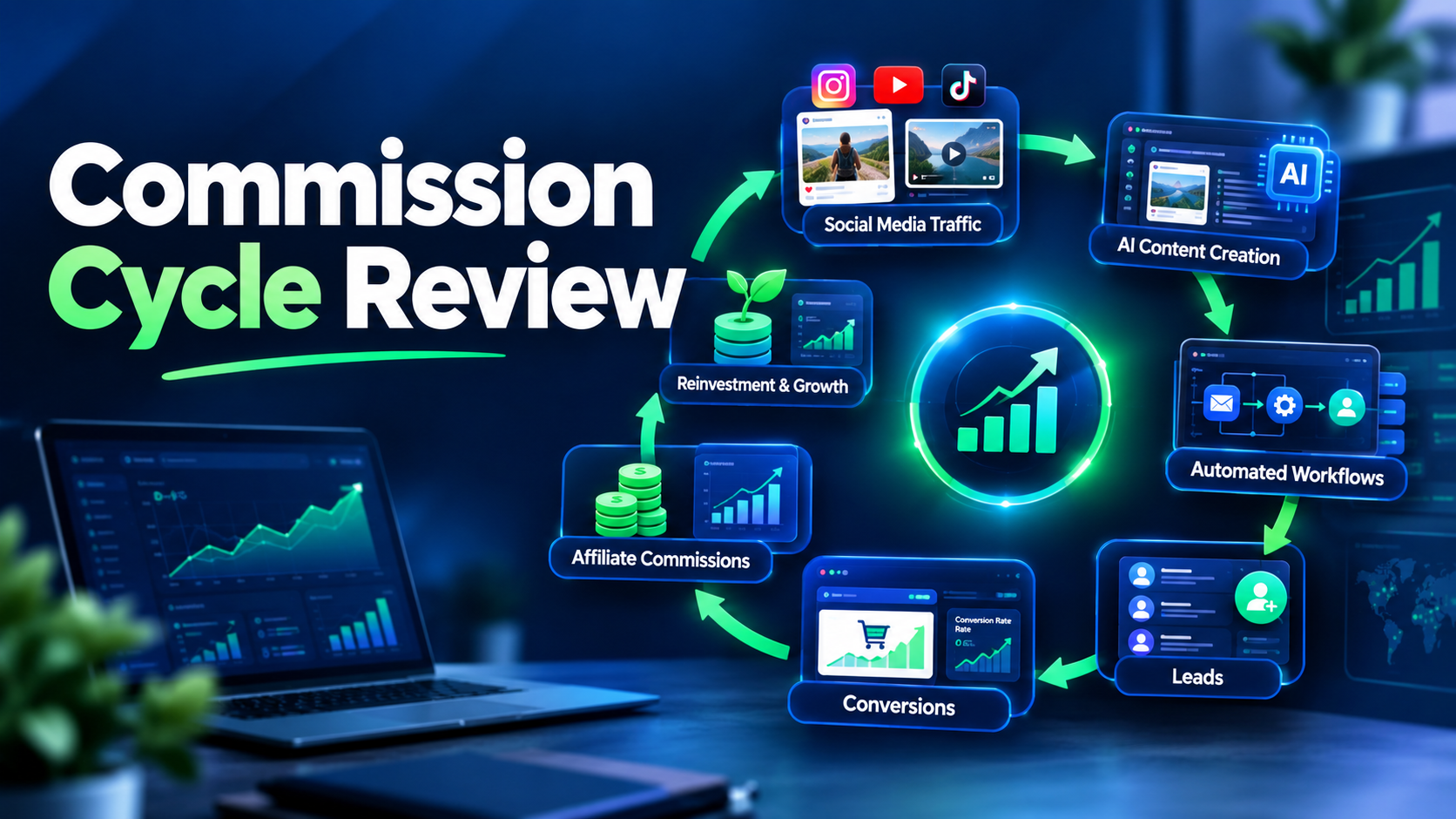
Generate commissions → reinvest part of the profit → improve one part of the business → generate more commissions → reinvest again.
The method focuses on four main factors that influence profit:
Leads × Conversions × Average $ per Sale × Average Number of Sales per Customer
The idea is that an affiliate business does not necessarily need to improve everything at once.
Instead, the method looks for the factor that is currently the easiest or cheapest to improve and puts part of the existing profits back into that area.
For example, reinvestment might involve purchasing additional traffic. At other times, it could mean creating organic content or building other assets that can generate traffic over time.
The important principle is to reinvest money the business has already generated rather than relying entirely on additional outside investment.
What Does Commission Cycle Teach?
One of the main characteristics of the training is its focus on individual strategies.
According to the course description, each session concentrates on one core strategy rather than trying to cover many techniques at once.
The goal is to keep each lesson focused and relatively simple to implement.
One of the strategies introduced at the beginning involves turning one-word replies and interactions on social media into business opportunities.
From there, the training covers different aspects of traffic generation, content creation, automation, affiliate promotion, and scaling.
Affiliate Marketing With AI Tools
AI is a major part of the Commission Cycle approach.
The training includes a collection of AI tools designed specifically around the method. These tools are intended to reduce the amount of manual work involved in creating and promoting content.
According to the product information, different tools are used for different tasks, including:
- Creating video scripts
- Producing social media posts
- Conducting research
- Creating videos
- Creating images
The basic workflow is designed to be simple.
For example, a user can describe what they want a video to accomplish, and the relevant AI tool can help create the script.
Other tools can then assist with the social posts, research, visual content, and other parts of the publishing process.
The overall idea is to use software to automate or accelerate tasks that would otherwise take considerable manual effort.
Where Does the Traffic Come From?
Commission Cycle primarily focuses on Instagram and YouTube as traffic sources.
These platforms are combined with automation and content-sharing strategies.
One of the tools mentioned in the training is ManyChat, which can be used to automate conversations and follow-up processes on supported social platforms.
The strategy also makes use of shareable resources designed to encourage content and offers to spread beyond the original audience.
An interesting part of the approach is that an email list is not required to start using the method.
However, email marketing is still taught because having an email list can provide another way to follow up with prospects and potentially increase the value generated from existing traffic.
The Two Main Niches
Commission Cycle primarily focuses on two areas:
1. Personal Development
Personal development is the main niche used throughout the training.
This is a broad market with many different subcategories, allowing affiliates to choose more specific topics rather than competing across the entire niche.
The course creator’s stated reason for focusing on personal development is previous experience and the size of the market.
Students are not necessarily restricted to this niche, however. The underlying method can be applied to other markets as well.
2. Make Money Online
The second major area covered is the Make Money Online (IM) niche.
The training aims to help students operate in both areas and potentially connect the two.
For example, an affiliate could build experience promoting personal development products while also working within the make-money-online market.
How Does the Commission Cycle Model Work?
This is arguably the most important concept in the training.
The model views profit as the result of four variables:
Leads × Conversions × Average Revenue per Sale × Customer Purchase Frequency
Instead of simply trying to increase traffic indefinitely, the method asks a different question:
Which of these four areas can be improved most efficiently right now?
Once that area is identified, a portion of the existing commission is reinvested into it.
If the investment produces additional commissions, part of those new commissions can then be reinvested again.
This creates a repeating cycle:
Profit → Reinvestment → Improvement → More Profit → Reinvestment
This is where the name “Commission Cycle” comes from.
Paid Traffic vs. Organic Growth
The reinvestment strategy isn’t limited to paid advertising.
Depending on what appears to be underpriced or most effective at a particular point, reinvestment can take different forms.
That could mean:
Buying traffic
or
Building organic assets
The underlying principle is to use existing business profits to improve the area that offers the best opportunity.
This makes the model different from a strategy that depends entirely on one traffic source.
The course creator also points to having changed traffic sources several times over many years while maintaining the same underlying approach to profit reinvestment.
In other words, the traffic source can change while the fundamental business model remains the same.
What Makes Commission Cycle Different?
There are several elements that stand out from the course description.
Focused Training
Each session is designed around one main strategy.
This can make the material easier to follow than training that introduces many unrelated tactics in the same lesson.
AI-Assisted Workflow
A significant amount of the manual content-production process is handled with dedicated AI tools.
This covers areas such as research, scripts, social posts, images, and videos.
Multiple Traffic Sources
The training does not depend on a single platform.
Instagram and YouTube are the primary sources discussed, while automation and shareable resources are used to support distribution.
Reinvestment-Based Scaling
Rather than simply telling affiliates to “get more traffic,” the Commission Cycle model focuses on identifying the business variable that can be improved most efficiently and reinvesting profits into it.
Is Commission Cycle Suitable for Beginners?
The approach may be interesting for beginners because the training is structured around individual strategies rather than presenting everything at once.
However, affiliate marketing still requires practical work.
Students should expect to spend time learning how to:
- Create content
- Understand their target audience
- Promote affiliate offers
- Generate traffic
- Test different approaches
- Analyze results
- Improve conversions
- Reinvest profits
The AI tools may reduce the amount of manual work involved, but they do not eliminate the need for strategy, testing, consistency, and decision-making.
Can You Use Commission Cycle Outside the Recommended Niches?
Yes, according to the course description, the underlying method is not restricted to personal development or the make-money-online niche.
The training emphasizes these markets because they are areas where the creator has significant experience.
The broader model — identifying leads, conversions, revenue per sale, customer value, and reinvestment opportunities — can potentially be applied to other affiliate markets as well.
The exact results, however, will depend on factors such as the niche, offer, audience, traffic source, competition, content quality, and execution.
Commission Cycle Pros and Cons
Potential Advantages
Focused lessons: Each session centers around one primary strategy.
AI tools: The system includes tools intended to accelerate research and content production.
Social traffic: The method focuses heavily on platforms such as Instagram and YouTube.
No email list required to start: The basic traffic approach can work without an existing email list.
Email can be added later: Building an email list is still encouraged as a way to expand the business.
Reinvestment model: The training provides a framework for thinking about how to use existing profits to scale.
Potential Limitations
AI does not guarantee results: Having AI tools can make content production faster, but traffic and conversions still depend on the quality of the strategy and execution.
Affiliate marketing takes testing: Finding profitable offers and traffic sources usually requires experimentation.
Platform dependency: Instagram and YouTube are important parts of the strategy, so changes in platform algorithms can affect traffic.
Results will vary: There is no guarantee that every student will achieve the same level of commissions or profits.
Final Thoughts
Commission Cycle takes a relatively simple concept and builds an affiliate marketing system around it.
Instead of treating traffic generation, conversions, and customer value as completely separate problems, the Commission Cycle Method connects them through reinvestment.
The central idea can be summarized in one sentence:
Use the profits your business has already generated to improve whichever part of the business currently offers the best opportunity for growth.
The training combines this model with social media traffic, AI-assisted content creation, automation, affiliate marketing, and the personal development and make-money-online niches.
Whether that approach is right for you will ultimately depend on your experience, available time, preferred traffic sources, and willingness to test and optimize your campaigns.
For anyone researching Commission Cycle before deciding whether to join, the most important thing is to understand that the product is not presented as a single traffic trick.
It is built around a broader profit-and-reinvestment framework, with multiple strategies designed to feed into the same cycle.